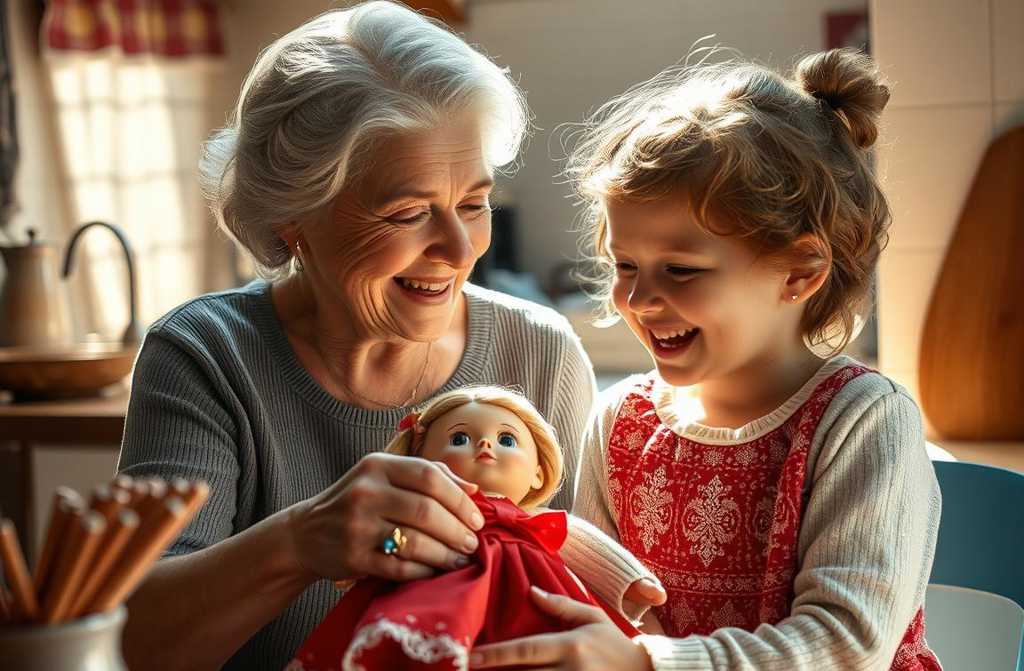
When I look back on those days, the memory of my grandmother, Margaret, comes most vivid. She became a grandmother at the age of fortyfour, and in that instant she seemed to settle into the role as society expected. She never roamed the streets in a gaudy kerchief with a cane; even in her later years she kept herself neat and dignified. I recall one summer in our little cottage near York when we sewed a bright scarlet dress for a doll together. I was thrilled and asked her whether she would ever want such a dress herself. She chuckled and replied, Goodness, Im a grandmother! That phraseIm a grandmotherechoed through every part of her life. The moment the first grandchild arrived, she slipped neatly into the mould drawn by tradition and by her own notion of what a grandmother should be, and she lived within those borders for the rest of her days, just as every woman of her circle did.
Now the younger generationthose in their forties and fifties often lament how much has been thrust upon them and how hard it is to live in an age of constant change. Yet it is that very generation that has shattered the old fences, the rigid ideas about what a certain age ought to look like. Imagine, for a moment, calling a woman just past her forties a grandmother. She is still a woman, a lovely lady even if not in the bloom of youth. She may no longer be a spring chicken, but she remains a lady, because her mind is still attuned to vitality rather than to age.
In my own recent experience, I discovered that a womans age can now only be guessed, and sometimes not even that, by the circumstances surrounding her. I spend many mornings in a tiny café on the high street of Bath, where the barista, a sprightly girl called Lily, already knows my order of a strong English breakfast tea with a splash of milk. We exchange a few light remarks; she is petite, graceful, with the fresh look of a university student just out of term. One day I walked in and saw a hulking man standing beside hera broadshouldered fellow nearly two metres tall. I wondered whether he could be her boyfriend, for she seemed almost a tiny figurine beside him. He bent over the counter, pressed a kiss to her cheek, and asked in a low voice, Darling, could you spare a few pounds? I thought, if that were his daughter, I would be less surprised.
What is most remarkable now is that a modern woman can decide for herself how she wishes to appear, which style and which age she feels comfortable wearing. She might choose braids and a tattoo on her hip, or sleek Louboutins and a dress with a daring neckline, or canvas trainers and ripped jeans, or lemonyellow blouses, narrow skirts and jaunty hats for each season. Red dressesshort, with a teasing zipper that runs the length of the backare no longer scandalous; no one shrugs or rolls their eyes. Even if someone does, she could not care less.
There is a saying that used to go, If youth knew, if age could. That phrase has vanished. The middleaged cohort scrubbed it away as if erasing a stain from a crisp tablecloth. Because today we all know things, yet we are still able to act upon them. This extraordinary generation refuses to dock at any single shore the old push away with dread, the young watch warily. The ship of our lives drifts on its own, thrilled by the adventure.
A revelation I have only recently embraced, and which I gladly share, is that age does not limit possibilities; it expands them. We no longer need to search for ourselves; we have already found who we are, and now we hone our craft or try new techniques in the pursuits that bring us joy. We no longer feel obliged to mingle with everyone, letting strangers into our lives. Our task now is to keep close those who beat in time with our own hearts. We can afford the luxury of pleasant companionship rather than merely the necessity of social interaction. In love and intimacy we seek quality, having learned long ago that quantity cannot replace it, and we know how to give our younger selves a hundred points of advantage.
We no longer rush our children to grow faster, for we have watched how swift that can be. Instead we savor their childhoods, filling them generously with what we once lacked. We have long understood that no amount of moneywhether pounds, shillings, or dollarscan purchase happiness, health, or loyalty. We also recognise that the road we travel toward a goal often matters more than the goal itself. Those who cannot relish the journey are unlikely to enjoy the outcome. We have proved this to ourselves, learned from our own errors, felt how quickly the years fly. The canvas of life is already sketched; now is the time to add the fine details and elegant strokes that turn a painter into a master and a painting into a masterpiece.
When this truth settles in, you realise that this very moment is when your possibilities are boundless. You may learn to dance, to sing, to play the harp, to study languages, to dive with scuba gear, to ride a horse, to ski or to rollerblade. You could blow glass vessels, drive a car, paint Christmas ornaments, paddle a kayak, set mosaic tiles, keep bees, colour playgrounds, mould pottery, stitch beads or do fine embroidery, bake delightful cakes, ferment cabbage into sauerkraut or roll fresh pasta by hand. You might travel and see with your own eyes the places you have only heard about. You could adopt a dog, take in a third cat, shoot your own short film or step onto a stage, move to the countryside, or finally begin the pursuit you have long postponed because time was scarce. You may lose yourself in a new romance, welcome another child, or simply stroll alone through a parks winding paths, breathing in the quiet, sipping a steaming mug of tea with a hint of lemon balm as the mist rolls in, savoring each sip as if it were a taste of autumn, of life itself.
Now we understand clearly that time is not infinite, and therefore we must cherish even more the age of limitless possibilities.