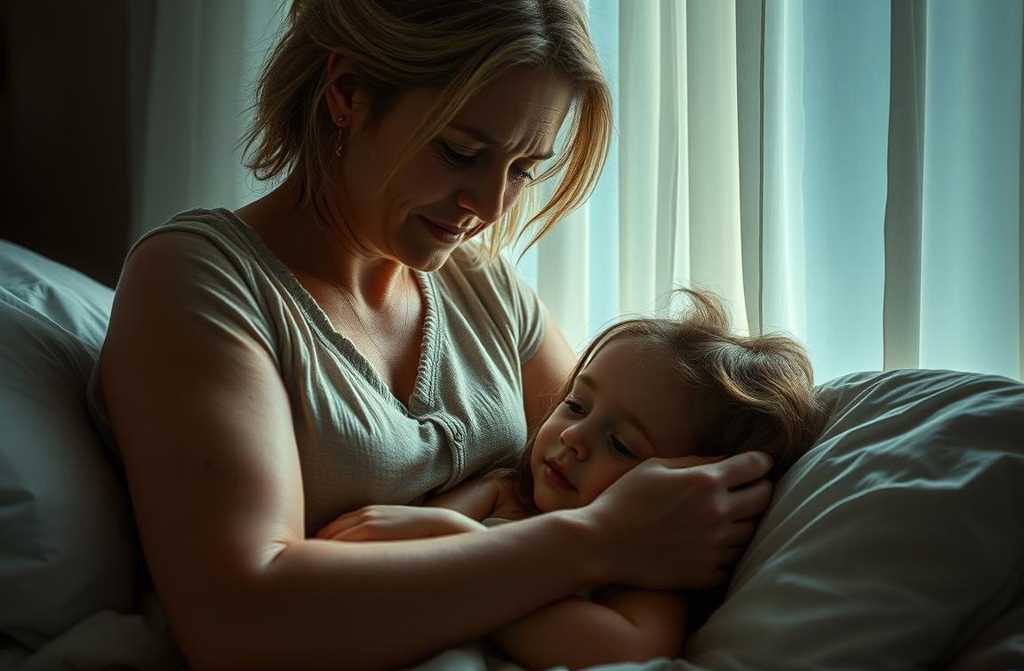
Women were born to endure, the husband would muse as he rode roughshod over his patient wife. But one day, she could bear it no longer.
In a quiet provincial town nestled among endless fields and dense woodlands, there lived a man named Arthur. He was in his forties, broad-shouldered and sturdy, with a coarse face shadowed by thick brows and a permanent squint, as though he were always judging others with disdain. He worked as a simple mechanic at the local factory, drawing a modest but steady wage. On weekends, he drank, and at home, he often raised his voice, believing himself the undisputed head of the householdnot by merit or respect, but because he had decreed it so.
His wife was called Margaret. She was a quiet woman, slight of frame, with dark hair like the night, always pulled into a tight, unassuming bun. She looked far older than her yearsonly twenty-eight, yet strangers might have guessed her closer to forty. Her eyes were weary, yet they held a deep kindness, eyes that had silently borne lifes blows like the earth enduring autumn rain.
They had bound their lives together ten years before. Back then, Margaret had been differentbright, quick to laugh, full of dreams. She had hoped to become a primary school teacher, but life had other plans. She fell pregnant, and Arthur had declared, firmly and without debate, «Youll study later. First, bear children, tend the homethats a womans true place.» She had believed him then, trusted in that simple truth. She set aside her exams, bore a son, and years later, a daughter. But she never became a teacher, leaving that dream in the distant past.
With each passing year, Arthur grew more certain in his conviction: women were made to endure.
He said as much to himself, to his few friends in the pub, and even aloud as Margaret scrubbed the floors of their modest home.
«A woman isnt a personshes a workhorse. Her duty is to keep the house in order, food on the table, and the children fed and clothed. If she dreams of anything else, let her endure it. Thats the way of the world, and theres no changing it.»
Margaret never argued. She only nodded, sometimes offering a faint, fleeting smile. She cooked, laundered, put the children to bed, soothed them when her son wept after his fathers shouting. She had long grown accustomed to being part of the furniturethe silent presence that made a house feel like a home, yet was seldom truly seen.
Arthur used her like a reliable vehicle, never maintained, never thanked, simply ridden until it broke down. He left dirty socks in the hallway, demanded dinner served sharp at seven, shouted if the soup was too salty. He never helped with the children, never asked after their schoolwork, never attended parent-teacher meetings. But if their son brought home poor marks, it was always Margarets fault: «Cant you keep an eye on him? Do you do nothing at all?»
At night, when the children slept, he sat before the flickering television with a bottle of ale, while Margaret stood at the kitchen sink, scouring pots until they gleamed, the familiar ache in her back spreading through her exhausted body. Sometimes she caught her reflection in the dark windowdim, blurred by raindrops, as though she herself had faded, as though she were no more than a ghost, a silent shadow serving others.
But one day something inside her turned, and she could endure no more.
It began with something small, almost insignificant.
That evening, Arthur returned home later than usual, angrier than a kicked dog. Margaret had already put the children to bed, tidied the kitchen, helped their daughter with her lessons. She stood at the stove, reheating his dinnerpotatoes and corned beef, the same as the night before, for money was tight until payday.
«Where are my slippers?» he barked as he crossed the threshold.
«By the bed, where they always are,» she answered softly, barely above a whisper.
«Theyre not there!» He flung his workbag to the floor. «Gone missing again!»
«I saw them this morningthey must be there…»
«I dont care where you saw them! Find them! Now!»
She went to the bedroom without a word, bent down, and peered under the bed. The slippers were there, of course. She handed them to him silently.
«Thanks ever so,» he sneered. «At least youre good for something simple.»
Margaret said nothing. She lowered her eyes, set the steaming plate before him, and sat opposite, though she had no appetite. She wished only to lie down, close her eyes, and vanish into silence.
«Why is this cold?» he shouted minutes later. «Cant you even heat food properly?»
«Its just come off the stoveits hot…»
«I dont care! Its cold! Heat it again!»
She took the plate back to the kitchen. Her hands trembled. Her eyes brimmednot from physical pain, but from the endless, years-deep weariness, the crushing weight of knowing she was valued not as a person, but as a tool for others demands.
And in that moment, something inside her clicked, like a long-forgotten mechanism stirring to life.
She set the pan back on the stove, lit the flame, watched the potatoes bubble. Then her gaze fell on the heavy butchers knife beside the cutting boardsharp, steel-bright.
For one terrible second, she thought: a single motion, and this torment would end. No more shouting, no more humiliation, no more endless «you must,» «you should,» «youre useless.»
Then a small, sleepy voice came from the childrens room:
«Mum, Im thirsty…»
It was her daughter, little Emily, five years old, in her favourite pyjamas, her hair mussed from the day. Margaret turned slowly. Saw those wide, trusting eyes, like a helpless pups.
And in that instant, she understood with perfect clarity: if she broke now, if she let herself disappearwho would protect Emily? Who would teach her to be strong, to refuse to live as her mother had, a shadow in her own home?
She turned off the stove. Went to her daughter. Held her gently. Whispered, soft and warm:
«Go back to bed, love. Ill bring you water in a moment.»
Then she returned to the kitchen. Served Arthur his reheated meal. Sat opposite him in silence.
But deep within, something had changed irreversibly.
The next day, she gathered her courage and went to the town libraryfor the first time in ten years. She borrowed a thick book on family psychology, read about toxic relationships, emotional abuse, how women endured for fear of change, fear of loneliness, fear of the unknown.
«You have a right to respect. You have a right to boundaries. You do not have to endure pain.»
She wept over those words, tears staining the page. Then she copied the most important lines into her old, battered notebook.
A week later, she found an online support group for women in situations like hers. There were others just like hershoulders slumped with hopelessness, stories of cruelty, fear, and degradation.
One woman wrote: «I lived with a man who called me worthless, filthy, just a housewife. I believed him. Then I found the strength to leave. Now Im studying psychology. My children and I live in our own little flat. He still calls, begging me to return. I just laugh.»
Margaret stared at the screen a long while. Then she closed the laptop. Went to the old wardrobe. Found her tattered student ID tucked away on the highest shelf. The photo showed a young woman with a radiant smile, a stack of books in her arms, eyes alight with dreams.
She traced a finger over the faded image, over the face of the girl she had been. Whispered, so softly it was almost soundless:
«I was like that once I was someone else.»
From that day on, she began to change.
Not all at once. Not loudly, not for show. But irreversibly, like a rivers current.
She smiled less when Arthur shouted. Stopped jumping to fulfil his whims. Sometimes she simply said: «Im tired. Wait a while, please.»
At first, he was merely puzzled. Then angry. Then he bellowed: «Have you lost your mind? Who do you think you are?»
But she stayed silent, gazing out the window. Or answered, strangely calm:
«I havent lost my mind. I just wont be your unpaid servant anymore.»
The first time, he fell quiet, staring at her as though she were a stranger.
A month later, she secretly enrolled in an online accounting coursesomething she could study at home. She pored over ledgers at night while he slept, sometimes dozing off at the table, the calculator slipping from her hand.
When he found out, he laughed scornfully:
«What are you studying for? To be some corner-shop clerk? Whod even want you?»
«Myself,» she said quietly but clearly. «I matter to me.»
He spat, slammed the door, and stormed to the pub.
Half a year passed. Days turned to weeks, weeks to months.
Margaret passed her first professional exam. Received her certificate. Found remote work with a small but steady firm. The pay was meagre, but it was hersthe first honest money shed ever earned.
She opened a secret bank account. Began savingfor a flat of her own, however small. She dreamed of two rooms where her children could sleep apart, where she could turn on a light without fear of shouting.
One evening, Arthur returned drunk to find no dinner waiting.
«Wheres my food?» he roared from the doorway.
«Im tired,» she said simply. «Make your own.»
He froze, disbelieving. Stared at her as though she were a traitor.
«What did you just say? Say it again!»
«Make your own. I worked all day. The children are asleep. Ive no strength left.»
«Have you gone mad? This is your job! Youre a wife! A mother!»
«Im a person,» she said, quiet but firm. «And I wont endure this anymore. Not any of it.»
He lunged, seized her wrist, squeezed until it hurt:
«Ill teach you a lesson! Where do you think youre going, eh?»
She didnt struggle. Only lifted her head and met his eyescalm, steady, fearless:
«Let go. Now. Or Ill call the police.»
«Whod believe you, stupid cow?» he laughed, though it was nervous. «Youre my wife. My property.»
«Im not property,» she said. «And if you ever lay a hand on me or the children again, Ill leave. For good. And Ill file for child support.»
He released her. But from that night, he looked at her differentlynot as a meek wife, but as a dangerous stranger.
Two more months passed.
Margaret found a small flatbright, clean, with space for potted plants on the balcony. She filed for divorce.
Arthur arrived in court drunk, shouting that shed «abandoned her family for ambition,» that «children need a father,» that «shes lying, shes not who you think.»
But the judge, a stern-eyed woman, reviewed the medical records (Margaret had been diagnosed with chronic stress), the neighbours testimonies (theyd heard the shouting), the statements from her support groupand ruled: the children would stay with their mother. Arthur would pay maintenance.
When the verdict was read, Margaret didnt weep. She simply exhaled, as though shed held her breath for ten years.
She moved into the empty flat. Hung new curtains. Put up prints of paintings she loved. Bought a secondhand bookcase. The children ran through the rooms, laughing, unafraid of sudden shouts.
One summer evening, with the children asleep, she stepped onto the balcony with a mug of herbal tea. The air was sweet with blossoms. Her plants thrived. Silence, deep and peaceful, surrounded her.
A friend from the support group called.
«How are you, Maggie? Really?»
«Good,» Margaret answered honestly. «Truly good. For the first time in years.»
«Has he come by?»
«Yes. Stood outside the building. Said he missed us. That Id ruined everything by leaving. That women were made to endure, not run away.»
Margaret gave a quiet laugh.
«What did you say?»
«I told him: Women were made to live. To be happy. To lovenot from fear or dependence, but freely. And if you cant love without cruelty, you dont deserve to stand on my doorstep.»
The friend was silent a moment.
«Well done,» she said at last. «Im proud of you.»
Margaret hung up. Leaned back, gazing at the starry sky. She remembered that terrible night at the stove, the knife in her hand, how close shed come to despair.
But in that moment, she had chosen not darknessbut light.
A year passed. Time heals, as they say.
Margaret secured a steady job, earned a promotion. Enrolled in a teaching coursedetermined, at last, to become that primary school teacher. Late, but not impossible.
The children thrived. Her son took up chess; her daughter painted sunlit pictures, often saying, «Mummy, youre the prettiest. I want to be just like you.»
One day, Arthur came to her doorsober, aged, his eyes full of sorrow.
«Forgive me,» he whispered, not meeting her gaze. «I was a fool. I thought strength was in commanding. But real strength is in respect.»
She studied himnot with hatred, not with pitysimply as a man who had stumbled through his own mistakes.
«I forgive you,» she said evenly. «But dont come back. Im not your workhorse, not your shadow. Im a woman. And Im finally living my own life.»
He nodded, turned, and walked away into the dusk.
She closed the door. Stood before the hall mirror. Studied her reflection.
Her eyes were no longer weary. They held something new, unshakablesomething no money could buy, no cruelty could break.
Her hard-won dignity.
Years later, when her children were grown, Margaret wrote a book. Its title was simple: *Women Are Not for Enduring*.
In it, she told her storyhonestly, without sugar-coating. How easily one could lose oneself. How hard it was to piece oneself back together. How endurance was not always virtue, not when the cost was ones soul.
The book became a surprise bestseller. Women wrote to her from across the country: «You saved me.» «Your story gave me strength.»
Men wrote too, less often: «I never understood before. Now I try to be better.»
On the final page, she wrote:
«Im no heroine. Just an ordinary woman who once decided: enough.
Enough pain. Enough silence. Enough fear.
I was not made to endure.
I was made to live.
And if youre reading thisknow that you deserve happiness too.
Even if the world says endure, you have the right to say no.
Because freedom begins with a single word. A single choice.
A single glance in the mirror.
A single refusal to be a shadow.
Be yourself. Find yourself.
Breathe. Dont be afraid.
Live. Just live. She closed the book, ran a hand over its cover, and smilednot the faint, fading smile of old, but one that reached her eyes, warm and sure. Outside, the sun rose over quiet streets, painting the sky in gold and soft pink. Another day. Another chance. She poured a cup of tea, stepped onto the balcony, and breathed deeply. The air was clear. The world was quiet. And for the first time in her life, she felt completely, unshakably free.