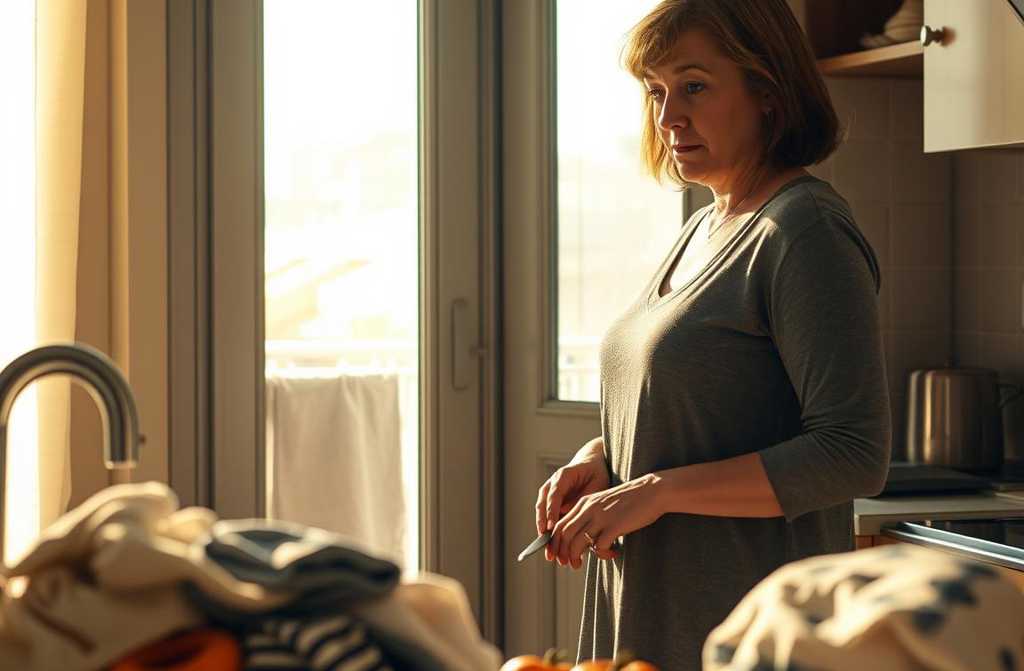
«I’m not your cook or your maid, to clean up after your son as well! If you’ve brought him to live with us, you can jolly well look after him yourself!»
Margaret paused, the knife hovering over the chopping board. The smell of fried onions and garlic, meant for her own supper, seemed to vanish, replaced by the bitter scent of her own rising irritation. She turned slowly. There, in the armchair, lay a crumpled heapjeans, T-shirts, socks twisted into hard little balls, all exuding the faint but unmistakable odour of teenage sweat and street dust.
She said nothing. She stared at the back of Edwards head as he lounged on the sofa, absorbed in the roar of engines from the racing cars on the telly. He hadnt even bothered to look at her when issuing his commands, as if addressing a piece of furniture or some automated assistant. Behind the closed door of the next room sat the boy himselfsixteen-year-old Henry, her «temporary» lodger for the past four months. The rapid clicks of a mouse and bursts of muttered swearing betrayed his immersion in some computer game. It wouldnt occur to him to tend to his own clothes or meals. Why should it? That was Margarets job.
«Im not your cook or your maid to clean up after your son as well! If youve brought him to live with us, you can jolly well look after him yourself!»
Her voice was steady, cutting through the screech of tyres from the television.
Edward frowned, turning his head at last with an expression of genuine bewilderment, as if shed addressed him in a foreign tongue.
«Whats got into you? Its not as though its difficult. Youre running the dishwasher anywaywhats the difference between two shirts or four? And you cook for us all. Why make a fuss over nothing?»
He spoke so plainly, so matter-of-factly, that Margaret felt a sharp, furious clarity. To him, there *was* no difference. She was an appliance, part of the household machineryfill with laundry, press start; empty shelves, restock. He didnt see her exhaustion after work, didnt notice the hours she spent at the stove while the two of them lounged. He simply consumed her time and her energy.
Without another word, she marched to the armchair, pinched the heap of filthy clothes between two fingers, and turnednot toward the washing machine, but the balcony.
«Where are you going with that?» Edward demanded, sitting up.
Margaret didnt answer. She slid open the balcony door. The cold November air stung her face. Stepping out, she reached the railingand without hesitation, let go. The dark bundle tumbled over the edge and vanished soundlessly into the night, landing somewhere on the lawn below.
She stepped back inside and shut the door firmly. Edward gaped at her, his face shifting from shock to fury as he rose from the sofa.
«Have you gone mad?» he roared when he found his voice.
«No,» Margaret said calmly, returning to her frying pan. «Ive come to my senses. I agreed to live with *you*, not adopt your overgrown child. From now on, you both fend for yourselves. Wash, cook, clean. My patience has run out. And tell your son his school uniform is on the lawn. Hed best fetch it before the binmen do.»
The roar of engines from the telly was drowned out by Edwards furious spluttering. Henry, drawn by the shouting, peered out from his room. His face, usually slack with boredom or lit by the glow of his screen, now registered confusion as he looked from his crimson-faced father to Margaret, serenely chopping vegetables.
«Dad, whats happened?» he mumbled.
«Whats happened?» Edward exploded, jabbing a finger toward the balcony. «Your clothes are fertilising the garden, thats what! She threw them out! Go and fetch your things before the dogs tear them apart!»
The humiliation on the boys face was almost tangible. King of his virtual realm, hed been publicly chastised and sent on the demeaning errand of retrieving his own laundry from beneath the block of flats. Not daring to glance at Margaret, he slipped into his trainers and scurried out.
Edward stood in the middle of the room, breathing hard like a cornered bull. He waitedfor shouting, tears, perhaps even an apology. But Margaret simply carried on cooking. Her icy composure infuriated him more than any row.
«Youll regret this, Margaret. Deeply,» he hissed, then flung himself back onto the sofa, glowering at the blank screen.
From that evening, the flat became a battlegroundsilent, but all the more bitter for it. Edward and Henry, returning with armfuls of damp, crumpled clothes, chose passive resistance. They were certain this was a passing tantrum, that shed crack if they held firm. Theyd prove they didnt need herwhile doing everything to make life unbearable.
The kitchen fell first. In the morning, Margaret rose as usual, made herself coffee, ate yoghurt, washed her cup, and left for work. Edward and Henry, finding no breakfast waiting, attempted to fend for themselves. The result: milk slopped across the hob, a pan of charred egg stuck fast, and a mountain of unwashed dishes. They left it all. Their first shot fired.
That evening, Margaret surveyed the mess, said nothing, cooked herself a light supper, ate, washed her plate, and retired. The pile in the sink didnt trouble her.
Days passed. The squalor grewpizza boxes on the floor, crisp packets on the sofa, sticky rings on the coffee table. The air thickened with the sour stench of neglect and stubbornness. They ignored the bin, heaping rubbish in a stinking mound beside it. They waited for her to breakfor her «womanly instincts» to crack, for her to cave and clean.
But Margaret didnt break. She built an invisible wall. Her path was clear: hallway, bathroom, kitchen, bedroom. She cleaned only her own space, cooked only for herself. Her room became a fortress of order in their sea of filth.
«The flats unbearable,» Edward muttered one evening as she passed.
«*Your* half, perhaps,» she replied without turning. «Mine suits me fine.»
His jaw clenched. Her calm, her indifference, grated. They were losing this cold war, but pride wouldnt let them admit it.
A week turned the flat alien. The kitchen table was sticky with cola, the sink reeked. Margaret moved through it like a curator in a museum of squalor. Their worlds ran parallel, never touching.
On the seventh day, Edward snapped. Her icy resolve had outlasted their rebellion. That evening, he rose with a cruel glint in his eye. If shed made her room a sanctuary, hed violate it.
Her bedroom was immaculatecrisp sheets, not a speck of dust. On the chair hung her new coat, cream-coloured, bought with her bonus. A symbol of her independence. The perfect target.
He returned with pizza crumbs and pickle brine, staining the sleeve with deliberate spite. Henry watched, silent.
When Margaret returned, she froze in the doorway. The ruin of her coat screamed malice. She touched the sticky fabric, and something inside her diednot anger, not hurt, just cold certainty.
She didnt shout. She folded the coat, placed it in the wardrobe, then picked up the phone.
«Hello? I need my locks changed. Today.»
The click of the front door was a gunshot. Edward and Henry stared at each other.
«Wheres she gone?» Henry whispered.
«Who cares?» Edward growled, though unease flickered in his voice. «Shell be back.»
But she wasnt.
Margaret acted with surgical precision. She bought black bin bags, waited in the courtyard until they left, then returned to the flatfor the last time.
Like a machine, she emptied Henrys roomclothes, headphones, dirty cups, all into bags. Edwards things followed: shirts, work boots, shaving kit. She purged every trace of them.
Forty minutes later, six bulging bags stood by the door. The locksmith arrived, drilled out the old lock, fitted a new one. The sound was liberation.
That evening, the key scraped uselessly in the lock. Fists pounded the door.
«Margaret! Open up! Whats this about?»
She sipped her tea. The banging grew frantic.
«All your things are on the landing,» she called calmly. «This isnt your home anymore.»
Edward roared. Threats, curses. She heard them rustling through the bags. Their rage meant nothing nowjust noise from a past life.
An hour later, silence fell. Theyd gone, dragging their bags into the nightto his parents, perhaps, or some dreary rented room.
Margaret aired the flat, lit a pine-scented candle, scrubbed away every memory of them. By dawn, the place gleamed. She drank coffee by the window, wrapped in a blanket, watching the city wake. Not lonelyfree.
A week later, Edward knocked. He looked haggard, holding a bag of her stray belongings.
«Margaret, lets talk. This has gone too far.»
She took the bag.
«Egors got nowhere to livewere crammed at Mums»
«Thats not my life anymore,» she said. «Its yours.»
«But were family!»
«No. Family is earned. You were a burden. And Ive shed you.»
She shut the door.
She heard later hed rented a room on the outskirts, sent Henry back to his ex-wife. Their lives were harder now.
Margarets, thoughhers was just beginning. She signed up for pottery classes, spent weekends as she pleased. In her spotless flat, she learned, at last, to be happy.